
Why Synchronous Search APIs Are Better for Agent UX
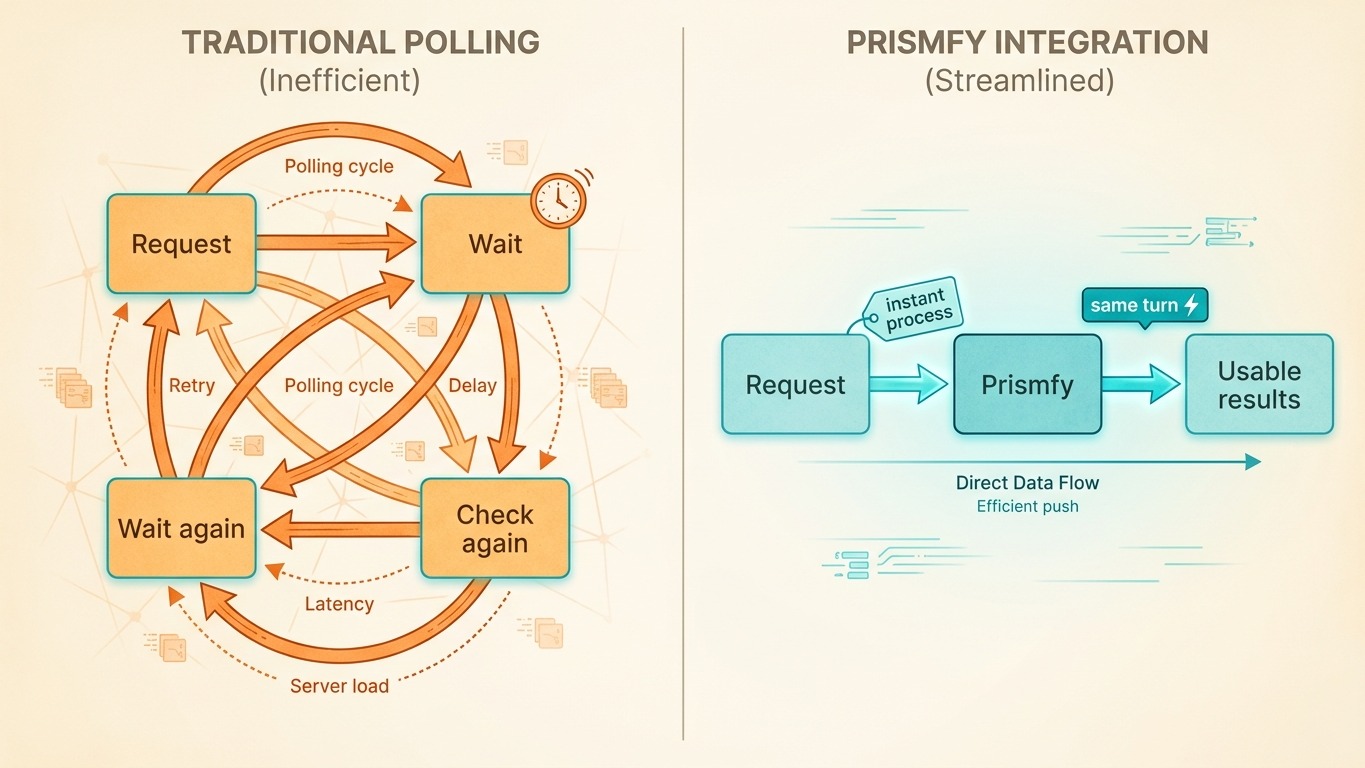
For agent workflows, synchronous search is easier to reason about than a queue-plus-poll model.
Prismfy Team
April 17, 2026
Why Synchronous Search APIs Are Better for Agent UX
For agent workflows, synchronous search is easier to reason about than a queue-plus-poll model.
You ask for evidence, wait for the response, and continue the loop. No extra job state. No second request. No stale intermediate status.
What changes in practice
A synchronous API gives the agent a simpler control flow:
- Receive the user request.
- Decide whether search is needed.
- Call Prismfy.
- Read the returned results.
- Continue the answer step.
That is a cleaner developer experience than splitting the same action into job creation and result polling.
Prismfy example
curl -X POST https://api.prismfy.io/v1/search \
  -H "Authorization: Bearer ss_live_YOUR_KEY" \
  -H "Content-Type: application/json" \
  -d '{
    "query": "latest pricing changes for competitor",
    "engines": ["brave", "bing"],
    "timeRange": "week",
    "language": "en"
  }'
Why agent UX improves
Synchronous search improves the workflow because:
- the agent state stays smaller
- the code path is easier to debug
- the response can be used immediately
- the developer does not need to build a poll loop
That matters most when the search step is part of a short, interactive agent turn.
Python example
import requests

def search_now(query: str) -> list[dict]:
    response = requests.post(
        "https://api.prismfy.io/v1/search",
        headers={"Authorization": "Bearer ss_live_YOUR_KEY"},
        json={
            "query": query,
            "engines": ["brave", "bing"],
            "timeRange": "week",
            "language": "en",
        },
        timeout=30,
    )
    response.raise_for_status()
    return response.json().get("results", [])[:3]

results = search_now("latest pricing changes for competitor")
print(results)
Common mistakes
- Confusing synchronous with "instant." It is still a normal network call.
- Overcomplicating the agent loop before validating the use case.
- Treating polling as a feature when it is usually just extra integration work.
If you want a simpler agent search flow, start with Prismfy docs and use synchronous POST /v1/search calls inside your loop.
Try it free
Add real-time web search to your AI
Free tier includes 1,000 one-time requests. No credit card required.